Pipeline

We are a research-driven biotech company dedicated to the discovery of first-in-class therapies addressing unmet needs. Our platforms and portfolio deliver NCEs and protein therapeutics against novel targets of relevance in oncology and neurodegeneration.
Partnered Programmes
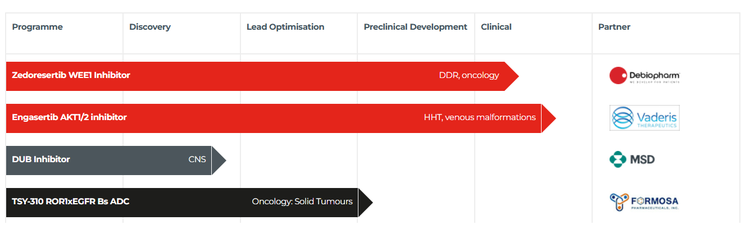
WEE1: Zedoresertib (DEBIO 0123), Ph1b, Oncology
WEE1 is a key regulator of the G2/M and S phase checkpoints, activated in response to DNA damage, that allow cells to repair their DNA before resuming the cell cycle. Inhibition of WEE1, particularly in combination with DNA damaging agents, induces an overload of arrests in the DNA damage response process.
- zedoresertib (Debio 0123) is a brain-penetrant, highly selective WEE1 kinase inhibitor.
- Discovered and developed by Almac Discovery and out licenced to Debiopharm in 2017
- Currently in Ph1 clinical studies in solid tumors and in combination with SoC in selected tumor types included CCNE-1 amplified ovarian cancer and glioblastoma
AKT: Engasertib (VAD044), Ph1/2, vascular malformations
Sustained over-activation of AKT drives abnormal vascular overgrowth, resulting in the formation of arteriovenous malformations (AVMs) and telangiectasia that are prone to rupture and bleeding. Hereditary Haemorrhagic Telangiectasia (HHT) is caused by mutations in either the ENG or ACVRL1 genes, giving rise to type 1 or type 2 disease, respectively. Patients with HHT develop telangiectasia predominantly on mucosal surfaces, including the nasal cavity and gastrointestinal tract. These fragile vascular lesions frequently rupture, leading to recurrent and uncontrolled bleeding that can progress to chronic anaemia and iron deficiency. Over time, this bleeding can become functionally debilitating and may necessitate repeated blood transfusions.
- There are no approved treatments for these diseases and current standard of care is limited to symptomatic relief.
- VAD0044 – allosteric sub-type selective AKT1/2 inhibitor: discovered and developed by Almac Discovery and out licenced to Vaderis Inc. for clinical development
- Proof-of-Concept clinical trial in HHT completed in 2025 in readiness for Ph3 initiation in 2026
ROR1xEGFR Bs ADC: TSY-310, preclinical, oncology
In May 2025, Almac Discovery and Formosa Pharmaceuticals (Taiwan) entered into a global, exclusive licensing agreement for TSY-310 (formerly ALM‑401), a first‑in‑class EGFR×ROR1 bispecific antibody–drug conjugate (ADC) for aggressive solid tumors. TSY-310’s smaller, single‑chain bispecific design aims to improve tumor penetration and manufacturability and has demonstrated highly promising preclinical efficacy in solid tumor models.
Deubiquitinase (DUB) Inhibitor: MSD, preclinical
Almac Discovery, as a leader in deubiquitinase drug discovery, entered into a research collaboration with MSD) focusing on the development of novel small molecule inhibitors against specified deubiquitinase (DUB) targets for the treatment of a range of neurodegenerative diseases.
Internal Programmes
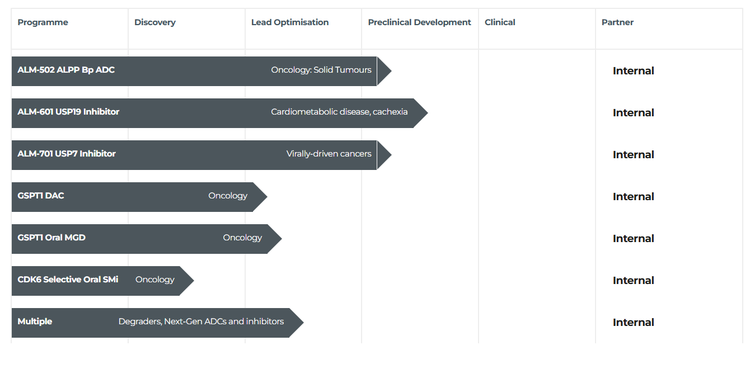
ALM-502: ALPP biparatopic ADC, preclinical
ALPP is only expressed during development with ultra‑low normal tissue expression, yet highly expressed across multiple solid tumors, where it is associated with poor prognosis and significant unmet need. High expression is seen in ovarian (including HGSOC), pancreatic, gastric, and bladder cancers, including drug‑resistant settings where ALPP is upregulated following standard‑of‑care treatment. ALM-502 includes a biparatopic VHH‑hFc ADC design, with a DAR2 payload and small molecular format, enables higher dosing, improved tumor penetration, and enhanced payload delivery. A vcMMAE payload with site‑specific conjugation provides bystander killing, immunogenic cell death, well‑understood safety, and an architecture designed to improve efficacy and therapeutic index versus conventional ADCs.
ALM-601: USP19 small molecule inhibitor, cardiometabolic disease/GLP-1 RA adjunct, IND-enabling
ALM‑601 is a first‑in‑class, oral, selective USP19 inhibitor currently in IND‑enabling studies, with Phase 1 entry planned for H1 2027. It features a differentiated, muscle‑focused mechanism designed to enhance the efficacy of incretin‑based therapies whilst improving overall body composition. In preclinical models in combination with GLP‑1 receptor agonists, ALM‑601 increases overall body weight loss, promotes fat‑selective weight reduction, preserves lean mass and strength, and improves insulin sensitivity. As an oral adjunct therapy, ALM‑601 aims to deliver injectable‑comparable weight loss with improved tolerability and broader patient access, addressing significant unmet needs in obesity and metabolic disease, particularly in high‑BMI patients, those with sarcopenic obesity, and poor responders to current therapies. ALM-601 also has shown significant muscle-protective effects in models of muscle-atrophy, such as cancer cachexia – a highly prevalent disease with no currently approved therapies.
ALM-701: USP7 small molecule inhibitor, EBV driven cancers, preclinical
ALM‑701 is a first‑in‑class, oral, selective USP7 inhibitor currently in late preclinical studies. Selective USP7 inhibition has the potential to address Epstein–Barr Virus (EBV)–driven cancers by targeting a key host pathway that EBV exploits for tumor survival. EBV‑positive malignancies rely on USP7 to stabilize viral and cellular proteins that promote oncogenesis, including factors that suppress tumor suppressor pathways such as p53 and support viral genome maintenance through EBNA1. By selectively inhibiting USP7, this approach may destabilize EBV oncoprotein function, restore normal tumor suppressor signaling, and reduce the survival advantage of EBV‑infected cancer cells. Importantly, because USP7 is a host enzyme rather than a viral target, inhibition may reduce the risk of viral resistance and provide a novel, mechanism‑based strategy for treating EBV‑associated lymphomas and epithelial cancers, either as monotherapy or in combination with existing treatments.
GSPT1 Degrader Antibody Conjugate (DAC):, Solid Tumors, preclinical
Degrader Antibody Conjugates (DACs) are a potentially transformative therapeutic modality that unite the tumour‑targeting precision of antibodies with the power of targeted protein degradation. Using a novel toolbox of potent, highly selective GSPT1/2 molecular glue degrader linker‑payloads, we have generated DACs against HER2 and CD33, identifying optimised payload combinations for each target. These DACs deliver robust GSPT1 degradation and potent cancer cell killing across solid‑tumour and haematological models, with in vivo studies underway. This approach is particularly well suited to HER2‑positive solid tumours (including breast and gastric cancers) and CD33‑positive haematological malignancies such as AML. The modular payload toolbox is now being extended into the bi‑specific DAC space, enabling broader tumour coverage and enhanced therapeutic precision.
GSPT1 Molecular Glue Degrader: oncology, preclinical
We have developed highly selective and novel molecular glue degraders of GSPT1 suitable for oral delivery. GSPT is a key regulator of protein translation essential to the survival of certain cancer cells. This mechanism has strong potential in acute myeloid leukemia (AML), high-risk myelodysplastic syndromes (MDS), and other translation‑dependent hematologic malignancies, where disruption of protein synthesis drives cancer cell death. GSPT1 degradation may also extend to select MYC‑driven solid tumors characterized by high translational stress. With oral dosing and a differentiated mechanism, GSPT1 MGDs represent a promising next-generation therapeutic option for patients with aggressive, molecularly defined cancers.
Selective CDK6 Inhibitor: oncology, preclinical
We have developed novel, oral and highly selective CDK6 inhibitors designed to precisely target cancers that are biologically dependent on CDK6, offering a differentiated alternative to dual CDK4/6 inhibition. CDK6 plays a central role in driving cell‑cycle progression through RB phosphorylation and E2F activation, and its overexpression defines tumor dependency in specific contexts. Large-scale dependency and genomic datasets show clear CDK6 reliance in selected solid tumors including brain, colorectal, esophageal/gastric, head and neck, and lung cancers, as well as hematologic malignancies, where CDK6 copy number and expression are elevated. By selectively inhibiting CDK6, this approach enables rational patient stratification and the potential for improved therapeutic precision in tumors where CDK4 inhibition is not required. Importantly, selective CDK6 inhibitors may offer an improved therapeutic index with regards to hematologic toxicity compared with dual CDK4/6 inhibitors by avoiding unnecessary inhibition of CDK4 in normal proliferating tissues, including hematopoietic progenitors.