

From Lab to Patient: The Importance of Stability Studies
When developing a pharmaceutical product, conducting stability studies is fundamental to determine a drug’s shelf life and ensure it remains safe and effective all the way to the patient.
Stability testing places the Active Pharmaceutical Ingredient (API) and drug product under various environmental conditions (such as heat, pH, humidity and radiation) to evaluate how they degrade over time. The data is used to guide how best to preserve the efficacy and integrity of the drug.
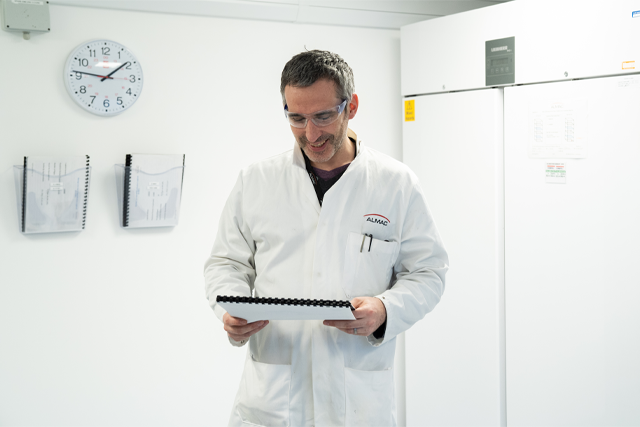
During early-stage formulation development, stability studies focus on understanding how the API degrades. This data is used to inform how API should be stored and handled to maintain its quality and purity. As formulation development progresses, the compatibility between the API and excipients (inactive ingredients) is tested. Furthermore, once the final product is packaged, further studies are required to ensure that the packaging method maintains drug stability.
The reliability of these studies depends on the robustness of the analytical methods used. At Almac, our UK, EU and US state-of-the-art, walk-in stability chambers are ICH (International Council for Harmonization) compliant. The rigorous validation process ensures our methods are reliable and can be used confidently throughout the stability study to accurately detect any degradation in products
Considerations for Stability Studies:
At Almac, our all-inclusive stability service includes protocol design, analytical method transfer, study management, sample analysis and QA approved reporting. Below are fundamental components that ensure safety, efficacy and regulatory compliance of pharmaceutical products.
Test Conditions: Simulating Real-World Scenarios
The standard guidelines ICH conditions guide the environmental settings for stability chambers, but this is dependent on the nature of the compound. Because of this, early-phase studies typically expose products to harsher conditions to accelerate degradation and gain an in-depth understanding of a compound’s stability profile.
Our state of the art, walk-in stability chambers provide 300m2 of ICH-compliant, climatic storage facilities to meet the requirements for long-term, intermediate, and accelerated stability studies, including transport simulation, freeze-thaw cycling, and in-use testing.
Transport and In-Use Stability: Real world Challenge
- Transport studies simulate the condition that a drug might face during shipping, such as temperature fluctuations. In addition, in-use stability studies mimic how patients handle the drug. These tests ensure the drug remains stable and effective throughout its use.
Reference Standards: Ensuring Consistency
- High-performance liquid chromatography (HPLC) and highly purified reference standards are essential for purity and assay testing. These tests need to be recertified periodically to ensure accuracy.


Regulatory Considerations and Compliance
- Stability studies must comply with regulatory guidelines set by regulatory agencies such as the FDA and EMA. Data must be readily available for review and teams should be trained and updated on the most recent regulatory changes and guidelines.
The Role of Technology/Future in Stability Studies
- Technological advancements have improved the efficiency and accuracy of stability studies. Automated systems for sample management and data collection reduce the potential for human error and streamline the process. ASAP Prime® allows for the rapid and accurate predictions of the stability and shelf life of pharmaceutical products. At Almac, we offer ASAP Prime® as an add-on service to accelerate your product pipeline.
To conclude, stability studies play a crucial role in early phase drug development. Such studies require expertise in analytics, environmental controls and logistics. With a skilled team, proven track record and efficient processes, clients can confidently navigate the complexities of stability testing to ensure their products are safe, effective and market-ready for their patient.